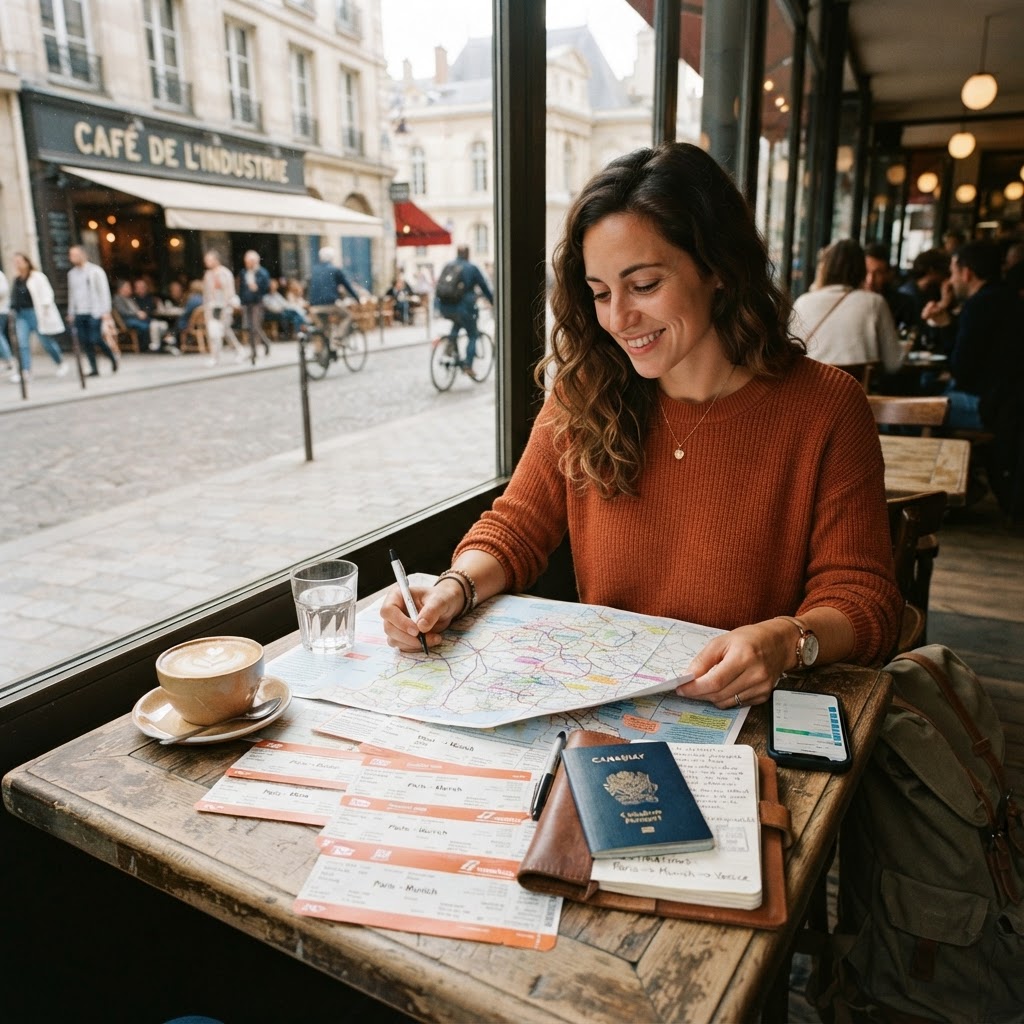
How to Plan a Multi-Country Europe Trip Without the Stress
Every year, travellers arrive in Europe with an ambitious list: Paris, Amsterdam, Prague, Vienna, Florence, Rome — ten days, six countries. They return home with a stamp collection and very little else. The cafés blurred into one another. The museums were rushed. The train stations were stressful. The hotels were fine but forgettable.
A multi-country Europe trip is one of travel's great possibilities. But its success or failure depends almost entirely on the approach.
Here is how to plan one that you'll actually remember.
Step 1: Choose a Theme, Not Just a List of Countries
The most common planning mistake is building an itinerary around countries or cities rather than around a unifying experience or theme. When you have a theme, every decision becomes easier — and the trip feels coherent rather than chaotic.
Possible themes for a European journey:
- →Wine & Gastronomy: Burgundy → Basque Country → Tuscany → Piedmont
- →Medieval Architecture: Bruges → Prague → Rothenburg → Český Krumlov
- →Coastal & Maritime: Amalfi → Cinque Terre → French Riviera → Dubrovnik
- →Imperial History: Vienna → Budapest → Kraków → Tallinn
- →Contemporary Art & Design: Rotterdam → Berlin → Copenhagen → Helsinki
A theme doesn't limit you — it focuses you. And focus, in travel, is what creates meaning. A Mediterranean-themed loop is a perennial favourite — see our Mediterranean travel guide for inspiration on where to include.
Step 2: Be Ruthless About Pace
This is the single most important piece of advice for any multi-stop European trip: you will see less of more places, or more of fewer places. Choose the latter.
A practical rule: spend a minimum of three nights in any destination you genuinely want to experience. Two nights means one full day — barely enough to orient yourself, let alone discover anything. Three nights gives you two full days and the growing sense of belonging somewhere.
For a 14-day trip, this means a maximum of four destinations. For many first-time multi-country travellers, this feels alarmingly restrictive. It is not. It is the difference between a trip and an experience.
What to cut: The most painful editing is always the places you've always wanted to see but that don't serve the itinerary's logic. If your core journey is France and Italy, resist the detour to Prague. Save it for a dedicated trip.
Step 3: Design Your Routing Around Transport
Europe's transport infrastructure — its high-speed rail network in particular — is one of the great gifts to the traveller. The Paris–London Eurostar takes 2h15m. Paris to Lyon is under 2 hours. Barcelona to Madrid is 2h30m. Milan to Florence is just under 2 hours.
By contrast, flying between European cities involves airports that are often outside city centres (budget airlines especially), security queues, and a boarding process that frequently absorbs as much time as the flight itself. For any journey under 4 hours, the train is almost always superior. Our dedicated guide to train travel in Europe covers the best routes and how to book them.
The High-Speed Routes Worth Knowing
- →London → Paris → Lyon → Nice (coastal France by train)
- →Paris → Barcelona → Madrid (Iberian arc)
- →Amsterdam → Cologne → Frankfurt → Munich (Rhine corridor)
- →Milan → Florence → Rome → Naples (Italian spine)
- →Vienna → Budapest → Bratislava (Danube triangle)
Book rail tickets as early as possible — typically 90 days out in Europe — for the best prices and seat selection.
Step 4: Logistics That Actually Matter
Accommodation Strategy
For multi-city trips, resist the urge to stay in the very centre of every major city. In Paris, yes — being walkable to the Marais, Saint-Germain, and the Seine is worth it. In Rome, yes. But in some cities, a neighbourhood hotel slightly removed from the tourist centre offers better value, quieter streets, and a more genuine experience.
Book accommodation before booking restaurants and experiences — your hotel's location shapes everything else.
Currency & Payments
Most of Western Europe has adopted the euro, but Switzerland (CHF), Denmark (DKK), Norway (NOK), Sweden (SEK), and the UK (GBP) have their own currencies. A travel credit card with no foreign transaction fees (Charles Schwab, Wise, or similar) and a small amount of local cash covers virtually all situations.
Communication
An international data plan or a local eSIM (available through services like Airalo) is far more practical than relying on hotel Wi-Fi. Navigate, translate, and book in real time without anxiety.
Step 5: The Art of the Open Day
One of the most valuable things you can build into a multi-country European trip is at least one entirely unscheduled day per destination. No museum bookings, no restaurant reservations. Just a neighbourhood to wander, a market to find, and no obligation to be anywhere.
These are almost always the days you remember most vividly.
Common Mistakes to Avoid
Booking restaurants only at famous places. Every major European city has a layer of tourist-trap restaurants near landmarks that are expensive and mediocre. The best meals are typically found two streets away, in restaurants that don't have English menus in the window and are full of locals at lunch.
Over-booking tours. One guided experience per destination — a private walking tour of a neighbourhood, a cooking class, a behind-the-scenes museum visit — is enriching. Three or four becomes exhausting and removes spontaneity.
Ignoring shoulder hours. The Louvre at 9pm on a Wednesday (it's open late) is a profoundly different experience from the same rooms at 11am on a Saturday. Most major European museums have late-night openings; most travellers don't use them.
Bringing too much luggage. On a multi-city European trip, you will lift your bags into overhead compartments, carry them up narrow hotel staircases, and navigate through crowds. A carry-on and a personal item is the civilised maximum. Everything else is a liability.
The Case for Expert Help
A multi-country European trip has more moving parts than almost any other type of journey: flights, trains, hotels in multiple cities, restaurant reservations, timed museum entries, private guides, airport transfers. Each element is manageable in isolation; together, they form a complex logistical web.
An experienced travel specialist manages this web for you — and more importantly, knows when an element doesn't serve the trip's larger purpose and should be cut.
"The best European journeys aren't the ones that cover the most ground — they're the ones where you were in the right place at the right time, with enough space to actually feel it."
At Extraordinary Travel, we design European itineraries that balance ambition with sanity, discovery with rest, and planning with spontaneity. If Europe is on your horizon — whether it's your first visit or your fifteenth — we would love to help you plan it properly.

Weekly · Curated · Unmissable
The world is waiting.
Discover it
extraordinarily.
Every week our travel editors distill years of on-the-ground experience into one beautiful email — packed with rare finds, hidden sanctuaries, and bespoke inspiration that elevates every journey.
- ✦Weekly insider travel insights
- ◈Rare destinations & hidden gems
- ◎Curated guides from our travel editors
Join discerning travellers from around the world. Unsubscribe anytime.